Document fraud is older than paper. Forged seals, altered contracts, and fabricated credentials appear in records from ancient Rome, medieval courts, and every era since. What has changed is scale, accessibility, and sophistication.
Today, a free online tool can generate a convincing bank statement in 90 seconds. A PDF editor available on any laptop can alter a salary figure without leaving a visible trace. Generative AI can produce a photorealistic passport image for a person who has never existed.
And most organisations accepting documents digitally (lenders, landlords, employers, insurers, KYC teams) are running verification workflows designed for a pre-digital threat model.
This guide covers everything: the taxonomy of document fraud, who commits it and why, what forensic signals expose it, which industries are most exposed, and how AI-powered detection has changed what's possible.
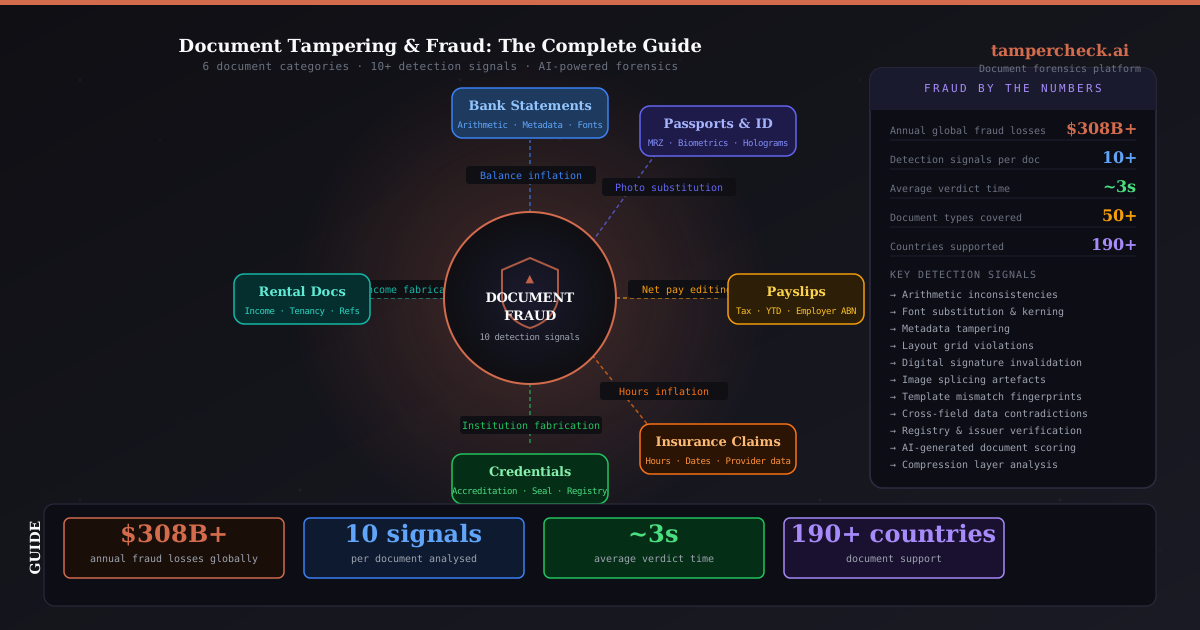
Part 1: What Is Document Tampering?
Document tampering is any unauthorised modification of a document's content, appearance, or metadata with the intent to deceive. It's a subset of the broader category of document fraud, which also includes fabrication (creating a document from scratch) and misuse (submitting a genuine document under a false identity).
The Three Core Categories
1. Alteration Modifying an existing genuine document. The original document was legitimately issued — only specific values have been changed. Examples:
- Changing the salary figure on a payslip
- Altering the closing balance on a bank statement
- Modifying the expiry date on an ID document
- Updating the address on a utility bill
Alteration is the most common form of document fraud because the fraudster starts with authentic source material (genuine fonts, real issuer branding, legitimate security features) and only changes what they need to.
2. Fabrication Creating a document from scratch, with no genuine original. Examples:
- Bank statements generated by online "statement generator" tools
- Payslips produced by fake payslip websites
- AI-generated passport images
- Counterfeit university degree certificates
Fabricated documents must replicate everything from scratch: layout, fonts, branding, and structure. Well-made fabrications are convincing to the eye but leave forensic traces that genuine documents don't.
3. Misuse Submitting a genuine, unaltered document that doesn't belong to the submitter. Examples:
- Using a friend's payslip with a better salary
- Submitting a family member's bank statement
- Claiming someone else's professional credential
Misuse doesn't produce a tampered document — the document itself is authentic. Detection requires identity matching (does the person submitting this document match the person on it?) rather than forensic document analysis.
Part 2: How Documents Are Tampered With
Understanding the methods is essential for understanding what forensic signals expose them.
PDF Editing
The most common attack vector for financial documents (bank statements, payslips, invoices) submitted as PDFs. PDF editors (Adobe Acrobat, Foxit, and dozens of free alternatives) allow users to:
- Select and delete text from a PDF's text layer
- Insert new text with matching font and size
- Place a white rectangle over existing content and type new values on top
- Use content-aware tools to "erase" values before replacing them
The resulting document looks identical to the original on screen. The forensic traces are in the PDF's structure: changed font metrics, altered compression blocks, modified creation metadata, and text layer/visual layer discrepancies.
Image Editing
For documents submitted as images (JPEG, PNG), such as photographed IDs, scanned bank statements, and photographed payslips, image editors (Photoshop, GIMP, Canva, and AI-powered tools) are the primary method.
Image editing leaves:
- ELA (Error Level Analysis) artefacts: re-compressed regions at altered boundaries
- Clone stamp traces: texture repetition where background was sampled to cover original content
- Lighting inconsistencies: edited regions that don't match the ambient lighting of the rest of the image
- Edge artefacts: boundaries between inserted content and original background
Online Generator Tools
Dozens of websites offer to generate fake bank statements, payslips, and utility bills. The user enters their desired values and downloads a professionally formatted PDF. These tools:
- Are free or cost a few dollars
- Require no design skill
- Produce output that passes visual inspection
- Leave consistent metadata fingerprints (the PDF creator tool identifies the generating website)
- Often produce documents that fail arithmetic checks (deductions don't match the salary) because the tool doesn't implement jurisdiction-specific tax calculations
Generative AI
The newest and fastest-evolving method. Text-to-image models and multimodal LLMs can now produce:
- Photorealistic images of identity documents for non-existent people
- Plausible bank statement layouts with consistent formatting
- Altered document images where the editing is harder to detect visually
AI-generated documents carry statistical signatures in pixel noise and spatial frequency that distinguish them from photographs of physical documents — but these signatures are narrowing as models improve.
The most dangerous document fraud isn't always the most sophisticated. A simple salary change in a PDF editor (taking 30 seconds) is invisible to visual review and defeats the majority of verification workflows in use today.
Part 3: The Industries Most Exposed
Document fraud concentrates in contexts where documents are the primary evidence for high-value decisions — and where the decision-maker has no direct relationship with the document's issuer.
Financial Services and Lending
The primary target. Loan applications, mortgage applications, and credit assessments rely on bank statements, payslips, and tax returns as income evidence. The financial incentive is direct: a fabricated income document unlocks a loan the applicant doesn't qualify for.
Attack patterns:
- Inflated salary on payslips
- Fabricated bank statement deposits
- Altered closing balances
- Synthetic identity document packages for entirely fictitious borrowers
Estimated exposure: The Federal Reserve Bank of Boston's landmark study, Synthetic Identity Fraud in the U.S. Payment System, found median losses of $81,000–$98,000 per affected account — and classified synthetic identity fraud as the fastest-growing financial crime in the US. The US Federal Trade Commission's Identity Theft Reports consistently rank financial fraud as the top category of reported identity crime.
See our detailed breakdown: How AI Catches Fake Bank Statements and Payslip Fraud Detection
Insurance
Claims are supported by invoices, quotes, medical reports, and photos. Fraud here ranges from individual claim inflation to organised rings submitting coordinated fabricated claims.
Attack patterns:
- Inflated repair invoices
- Phantom supplier quotes
- Altered medical reports with changed diagnosis codes
- AI-generated damage photos
Estimated exposure: The Coalition Against Insurance Fraud estimates that insurance fraud costs the US industry over $308 billion annually across all lines. The FBI's Financial Crimes report classifies insurance fraud as one of the costliest white-collar crimes in the country. The 10% of claims cost figure is widely cited across the UK, Australian, and US insurance markets.
See our deep dive: Insurance Claim Document Fraud Detection
Tenancy and Property
Rental applications require income evidence (payslips, bank statements) and identity documents. The fraudster gains a tenancy they can't afford — with eviction proceedings as the delayed consequence for the landlord.
Attack patterns:
- Inflated payslip salary
- Fabricated bank statement with regular income deposits
- Borrowed payslip with name substituted
- Fake employment reference letters
Estimated exposure: High-demand rental markets, particularly in Sydney, London, and New York, see elevated fraud rates during competitive application periods, driven by free online tools that generate convincing income documents in minutes.
HR and Employment Screening
Credential fraud (fabricated degrees, altered professional licences, forged reference letters) allows unqualified individuals to be hired into roles they can't perform. Liability consequences in regulated professions (healthcare, law, engineering, finance) can be severe.
Attack patterns:
- Purchased degrees from diploma mills
- Altered genuine certificates (changed grade, name, or qualification title)
- Fabricated reference letters from non-existent employers
- Professional licence certificates from non-accredited bodies
Estimated exposure: HireRight's Employment Screening Benchmark Report consistently finds discrepancies in a significant share of screened candidates. In regulated industries — where a fake medical or legal credential has patient or client safety implications — the downstream liability can dwarf the direct fraud cost.
KYC and Regulatory Compliance
Financial institutions, fintechs, and regulated businesses must verify identity documents as part of AML/KYC obligations. Failure to catch fraudulent documents has regulatory consequences beyond the immediate fraud loss.
Attack patterns:
- Altered passport or driver's licence (name, date of birth, expiry)
- AI-generated synthetic identity documents
- Face substitutions on genuine identity documents
- Utility bills with modified addresses
Estimated exposure: Regulatory enforcement bodies, including the UK's Financial Conduct Authority (FCA), the US Financial Crimes Enforcement Network (FinCEN), and AUSTRAC in Australia, have all published specific guidance on document fraud risks in KYC workflows. KYC-related enforcement fines have reached hundreds of millions of dollars in major actions, independent of the underlying fraud losses.
See: Automated KYC Document Verification and Deepfake Document Fraud in KYC
Part 4: The Forensic Signals That Expose Document Fraud
Modern AI document forensics runs multiple independent checks simultaneously. Each signal targets a different aspect of document integrity.
Signal 1: Error Level Analysis (ELA)
ELA exploits a property of JPEG and PDF compression: when an image is re-saved after editing, the re-compression doesn't apply uniformly. Edited regions show elevated or suppressed error levels compared to unedited background.
What it catches: Any region that was modified in an image editor before resubmission — salary figures, balance amounts, name fields, dates.
Limitation: ELA is most effective on images; less applicable to natively digital PDFs with no image layer.
Signal 2: Font and Character Metrics
Legitimate documents are rendered in a single pass by the issuing system. Every character is rendered with consistent font metrics: letter spacing, weight, x-height, and baseline alignment.
When a value is changed in a PDF editor, the replacement text has metrics that are statistically different from the surrounding text — even when the fraudster selects the "correct" font. These differences are invisible to the eye and measurable at the character level.
What it catches: Individual altered values in PDFs — a single changed salary figure, a modified balance, a replaced date.
Signal 3: Arithmetic Integrity
Every financial document must satisfy mathematical identities:
- Bank statement: opening balance + credits − debits = closing balance, and the running balance chain must be consistent row-by-row
- Payslip: gross pay − deductions = net pay, with deductions consistent with jurisdiction-specific tax tables
- Invoice: line item totals must sum to subtotal; tax must equal the applicable rate applied to subtotal
A fraudster who inflates one value must correctly recalculate all dependent values — or the arithmetic breaks.
What it catches: Any value alteration that wasn't accompanied by a full, correct recalculation of all dependent fields.
Signal 4: Metadata Analysis
Every PDF carries metadata: the software that created it, the creation timestamp, and for modified documents, the modification timestamp and modifying application.
A legitimate bank statement PDF has metadata consistent with the bank's internal systems. A statement generated by an online tool has metadata identifying that tool. A statement modified in Acrobat has both creation and modification metadata that can be cross-referenced against what the document claims to be.
What it catches: Fabricated documents (wrong creator tool), documents modified after initial creation, documents with implausible creation dates relative to their stated date range.
Signal 5: Text Layer vs. Visual Layer Discrepancy
Legitimate PDFs generated by institutions embed a text layer that exactly matches the visual content. When content is edited visually (for example by pasting an image over original text), the text layer retains the original values.
AI agents compare the extracted text layer against OCR of the visual layer. A discrepancy reveals what was changed.
What it catches: Visual-layer-only edits where a white rectangle was placed over original content and new content pasted on top.
Signal 6: MRZ Validation
Machine Readable Zones in passports and some ID cards encode document data in a format governed by ICAO 9303, with check digits that must validate against each field.
A name change, date modification, or document number alteration that isn't reflected in the correct check digit creates an immediate validation failure.
What it catches: Altered identity document fields that break MRZ arithmetic.
Signal 7: Template and Layout Matching
Every issuing institution maintains consistent document templates. Field positions, column widths, row heights, header layouts, and branding placements follow fixed specifications within each document series.
Forensic layout analysis compares the submitted document against known-genuine templates and flags deviations — inserted rows, shifted fields, altered column boundaries.
What it catches: Row insertions, field repositioning, and structural changes that alter the document's layout from the genuine template.
Signal 8: Employer and Issuer Verification
The organisation named on a document should be verifiable in public registries. ABN checks, company registration lookups, and professional registration databases confirm:
- The claimed employer exists
- Its registration status is active
- Its registered business category is consistent with the claimed industry
- Its registered name matches the name on the document
What it catches: Non-existent employers on payslips and references; non-existent utilities on utility bills; non-existent institutions on credential documents.
Signal 9: AI Generation Detection
Synthetically generated document images have statistical properties that distinguish them from photographs of physical documents:
- Pixel noise profiles consistent with generative model output rather than camera sensors
- Missing physical artefacts (paper texture, optical depth, natural lighting variation)
- Spatial frequency characteristics inconsistent with optical capture
What it catches: Fully AI-generated identity documents and supporting documents.
Signal 10: Cross-Document Consistency
When multiple documents are submitted together (an identity document, a bank statement, a payslip, and a utility bill), they must be mutually consistent. The same name must appear consistently across all documents. The address on the bank statement must match the address on the utility bill. Salary deposits in the bank statement must be consistent with the gross-to-net pay on the payslip.
What it catches: Coordinated fraud packages that use different source documents, or make inconsistent alterations across multiple documents, for the same applicant.
Part 5: What AI Detection Looks Like in Practice
All ten signals above are checked automatically, in parallel, in approximately 3 seconds per document.
The output is a structured verdict:
{
  "verdict": "suspicious",
  "confidence": 0.87,
  "signals": [
    {
      "check": "ela_analysis",
      "result": "elevated_artefacts",
      "severity": "high",
      "detail": "Compression anomalies at closing balance field consistent with value substitution."
    },
    {
      "check": "font_metrics",
      "result": "outlier_detected",
      "severity": "medium",
      "detail": "Closing balance character spacing is a statistical outlier vs. surrounding fields."
    },
    {
      "check": "balance_arithmetic",
      "result": "pass",
      "severity": null
    }
  ],
  "summary": "Two correlated signals detected at the closing balance field. Manual review recommended."
}
The plain-English summary, signal breakdown, and confidence score give human reviewers everything they need to make a rapid, well-informed decision — without running the forensic checks themselves.
Part 6: The Human-in-the-Loop Model
AI document verification doesn't eliminate human judgment — it concentrates it where it adds value.
The optimal workflow routes documents into three streams based on the AI verdict:
Auto-approve (verdict: clear, confidence > 0.9): all checks pass, no anomalies. These documents proceed without any human review. In a well-implemented workflow, this is 60–80% of submissions.
Targeted review (verdict: suspicious, confidence 0.6–0.9): one or more elevated signals. These route to a human reviewer with the AI's findings pre-loaded — the reviewer knows exactly what was flagged and where to look.
Escalate or decline (verdict: likely tampered, confidence > 0.9 for fraud signals): multiple high-confidence anomalies. These route to a compliance or fraud team with the full forensic breakdown as the documented basis.
This model reduces the volume of documents requiring human review by 70–90% while improving the quality of reviews that do happen — reviewers receive forensic context rather than starting from scratch.
Part 7: Staying Ahead as Methods Evolve
Document fraud methods evolve continuously. The landscape in 2026 is meaningfully different from 2023:
- AI generation tools have improved — synthetic documents are more visually convincing
- AI-assisted editing has improved — tools that match fonts, lighting, and texture automatically make alterations harder to spot
- Fraud-as-a-service has grown — organised suppliers sell complete document packages targeting specific use cases (rental, mortgage, KYC)
Detection has kept pace through multi-signal approaches: a document that defeats one check rarely defeats five independent checks simultaneously. The forensic constraints that genuine documents satisfy (arithmetic, metadata consistency, pixel statistics, layout, and structure) are harder to satisfy simultaneously as a forger than any single check is to defeat individually.
The key principle for any organisation accepting documents digitally: no single check is sufficient; the combination is what matters.
The best indicator of a well-designed document verification system isn't whether it catches the most obvious fakes — it's whether it catches the subtle ones: a single altered value in an otherwise genuine document. That's where the volume of real-world fraud lives.
Summary: The Document Fraud Checklist
| Category | Key Checks |
|---|---|
| Bank statements | Balance arithmetic, running total chain, ELA, font metrics, metadata, text-layer comparison |
| Payslips | Gross-to-net arithmetic, YTD consistency, employer ABN, font metrics, ELA, creator metadata |
| Identity documents | MRZ validation, photo zone integrity, template matching, AI generation detection |
| Invoices / quotes | Line item arithmetic, GST/VAT calculation, ABN verification, sequential numbering |
| Credentials | Institution accreditation, template matching, seal analysis, font identification |
| Utility bills | Issuer verification, date recency, address extraction, structural integrity |
| Cross-document | Name consistency, address consistency, employer consistency, salary-to-deposit consistency |
Run forensic checks on any document
Upload any document type and get a multi-signal forensic verdict in under 3 seconds. See exactly which checks pass and which flag. $5 free to start — no key required.
Start free →Go Deeper: Document Fraud by Type
This guide covers the full landscape. For forensic detail on specific document types, industries, and technical patterns — explore the TamperCheck blog:
| Topic | Post |
|---|---|
| How AI agents detect forgeries | AI Agent Document Fraud Detection |
| Bank statement tampering signals | Tampered Bank Statement Detection |
| KYC automation with AI | Automated KYC Document Verification |
| Fake passport forensics | Fake Passport Detection |
| Payslip fraud and income verification | Payslip Fraud Detection |
| Insurance claim document fraud | Insurance Claim Document Fraud |
| Fake degrees and credential fraud | Credential Fraud and Fake Degree Detection |
| Rental application fraud | Rental Application Document Fraud |
| Deepfake documents in KYC | Deepfake Document Fraud |
| Synthetic identity fraud | Synthetic Identity Fraud |
| Document tampering vs OCR | Tampering Detection vs OCR |
| Liveness detection vs forensics | Liveness Detection vs Document Forensics |
| Developer API integration guide | Document Verification API Guide |
| BYOK pipeline architecture | AI Verification Pipeline with BYOK |
Frequently Asked Questions
What is the most common type of document fraud?
By volume, altered financial documents (bank statements and payslips with inflated values) are the most common. They require minimal skill (a PDF editor and 5 minutes) and are submitted in enormous numbers through lending, rental, and KYC workflows.
Is document fraud a criminal offence?
Yes, in all major jurisdictions. Document fraud typically constitutes forgery, fraud by false representation, or both — carrying potential custodial sentences. Submitting a false document in support of a financial application is prosecuted separately from any fraud arising from the approval.
Can a document fraud be undetectable?
Practically speaking, no. A document that passes ELA, font metrics, arithmetic, metadata, text-layer comparison, template matching, and cross-document consistency simultaneously would require regenerating the document using the issuer's exact internal systems, which is inaccessible to fraudsters. Real-world fraud defeats one or two checks and is caught by the remaining ones.
How do I know if a document I've received has been tampered with?
Submit it to an AI forensic verification service. Visual inspection by a human reviewer — even a trained one — cannot detect font metric anomalies, ELA artefacts, or metadata inconsistencies. These require automated analysis.
What should I do if I suspect a document I've received is fraudulent?
Document your suspicion (save the original submission, the AI verdict if applicable, and any correspondence). In financial services and regulated contexts, this may trigger a Suspicious Activity Report (SAR) obligation. Seek legal or compliance advice before taking further action or informing the submitter.
How does AI document verification handle documents from less common countries?
Coverage varies. Common document types from major issuing countries (US, UK, EU, Australia, Canada, major Asian economies) have high accuracy. Less common source countries have wider confidence intervals. An "inconclusive" verdict for a low-coverage document type triggers manual review rather than a forensic-based decision.
Does AI verification work on documents that have been scanned or photographed?
Yes. Both photographed physical documents and natively digital documents (PDFs exported directly from banking or payroll systems) are supported. The AI adapts its analysis approach based on whether the document is a photograph or a digital original — different forensic signals apply to each.