When most people hear "deepfake," they think of manipulated video — a politician's face on someone else's body, or a celebrity in a fabricated interview. The fraud industry moved on from that use case a while ago.
Today's deepfake threat in financial services and KYC is quieter and more profitable: AI-generated identity documents. A synthetic passport that never existed. A fabricated driver's licence with a real-looking hologram. A generated utility bill with a plausible address, date, and account number.
These documents are designed not to fool a person at a border crossing — they're designed to fool a digital KYC workflow at scale.
What "Deepfake Document Fraud" Actually Means
The term covers three distinct attack types — each requiring different detection approaches:
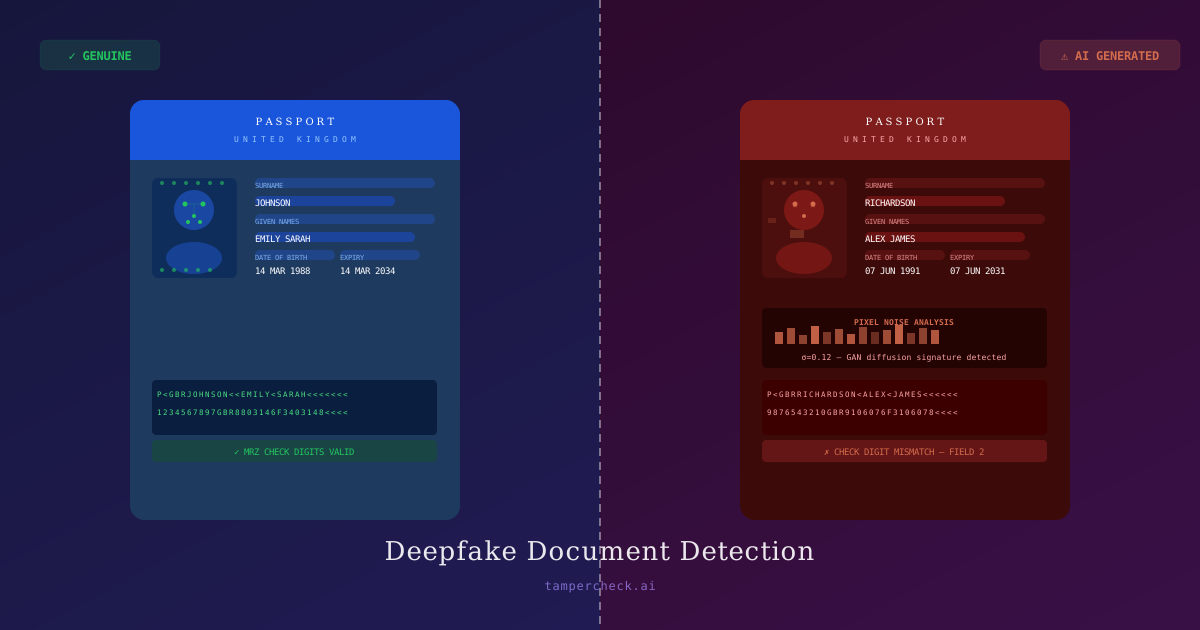
Type 1 — AI-generated documents: Created entirely by generative AI. No physical original ever existed. The model is given a target country, document type, and claimant details, and outputs a photorealistic image of a passport or driver's licence that has never been issued by any government.
Type 2 — AI-assisted alteration: A genuine document, with one or more fields (name, date of birth, expiry, address) changed using AI-powered editing tools that match fonts, lighting, and texture automatically. These are significantly more convincing than manual edits.
Type 3 — AI face swaps on genuine documents: A real document with the portrait zone replaced by an AI-generated or AI-transplanted face. The document is genuine; the identity claimed is not.
All three are increasingly accessible. The tooling is consumer-grade. The skill barrier is effectively zero.
Why Traditional KYC Doesn't Catch Them
Traditional digital KYC runs two checks:
- Template matching — does the document layout match a known template?
- Liveness detection — is the person holding the document physically present?
Type 1 attacks (fully synthetic documents) can now match templates well enough to pass basic template checks — AI models trained on real document images learn the correct layout, font spacing, and field positions.
Type 3 attacks (face swaps on genuine documents) pass liveness detection because the fraudster is physically present — they're just not the person on the document. The liveness check confirms "a human is here"; it doesn't confirm "this human matches this document."
Liveness detection and document template matching solve different problems from document forensics. A document can pass both checks and still be a deepfake. Forensic analysis at the pixel and metadata layer is what catches the difference.
What Forensic Detection Looks Like for AI-Generated Documents
AI-generated documents have statistical signatures that distinguish them from photographs of genuine physical documents:
Pixel noise profiles: Genuine document photos taken with a camera have sensor noise characteristics — random, hardware-specific patterns in the image. Diffusion models and GANs produce images with smooth, over-regularised textures that lack these properties.
High-frequency edge behaviour: Real photographs have natural blur gradients at edges caused by optics and depth of field. AI-generated images handle edges differently — often too sharp or with characteristic ringing artefacts.
Security feature inconsistency: Holograms, guilloche patterns, and microprint on genuine documents have physical depth. AI models approximate these visually but fail to replicate the underlying spatial structure — detectable in Fourier and frequency-domain analysis.
Missing physical artefacts: A photographed genuine document shows paper texture, slight curl, ambient lighting variation. AI-generated "photos" of documents typically render on a perfect flat plane with uniform lighting — a non-occurrence in genuine document capture.
Metadata absence or inconsistency: An AI-generated image submitted as a JPG lacks the camera sensor metadata of a genuine photo. Consistent absence of EXIF data is a signal, especially when combined with other indicators.
For AI-assisted alterations (Type 2), the additional forensic signals are:
- Boundary artefacts at edited regions — ELA highlights where AI-assisted editing has altered compression structure
- Lighting inconsistency — AI-inpainted text doesn't always match the ambient lighting of the surrounding document
- Font metric deviation — even AI-matched fonts have measurable metric differences from the original document's typeface
The Detection Stack: Three Layers That Catch All Three Attack Types
No single check catches all three deepfake document types. A robust detection stack combines:
| Layer | What it catches |
|---|---|
| Forensic pixel analysis (ELA, noise profile, frequency domain) | Type 1 (synthetic), Type 2 (AI alteration) |
| Template and layout matching | Type 1 (if model isn't well-trained on target) |
| Photo zone integrity analysis | Type 3 (face swap on genuine doc) |
| MRZ and data field validation | Type 1 and Type 2 (data inconsistencies) |
| Metadata and EXIF analysis | Type 1 (missing camera metadata) |
| AI generation signature detection | Type 1 (GAN/diffusion statistical fingerprints) |
Run in combination and completed in under 3 seconds, this stack catches the majority of deepfake document attacks — including the ones that pass individual checks in isolation.
What This Means for Your KYC Workflow
If your KYC stack currently runs template matching + liveness detection, you have a meaningful gap. The question isn't whether deepfake document attacks will be attempted against your workflow — it's whether your current stack will catch them when they are.
The integration path is straightforward: add a document forensics API call at the point of document upload, before the document's extracted data is used for any downstream decision. The check takes 3 seconds, costs a fraction of the fraud it prevents, and produces a structured verdict with a plain-English signal breakdown.
TamperCheck runs all five detection layers (pixel forensics, template analysis, photo zone integrity, MRZ validation, and AI generation detection) on every submitted document. The result is returned before a human reviewer ever sees the submission.
Test your documents against deepfake detection
Submit any identity document and see which forensic signals fire — AI-generated, altered, or genuine. $5 free to start.
Test a fake document →FAQ
- Can AI deepfake detection keep up with AI document generation?
It's an adversarial race, but detection has structural advantages: AI-generated documents must satisfy multiple independent forensic constraints simultaneously (pixel statistics, metadata, MRZ arithmetic, spatial frequency), while failing any one is detectable. Generation models optimise for visual plausibility, not forensic evasion — and the two objectives are increasingly in tension.
- Does deepfake document detection work on low-resolution submissions?
Detection accuracy degrades with resolution, as some forensic signals (microprint, fine hologram structure) require sufficient resolution to analyse. Most mobile-captured document photos are sufficient. Platforms should enforce a minimum resolution requirement at upload.
- Is this different from the deepfake video detection used in biometric verification?
Yes. Deepfake video detection (used in liveness checks) analyses facial movement and temporal consistency in video frames. Document forensics analyses still images of documents for physical and metadata inconsistencies. They're complementary — different tools for different fraud vectors. For a full comparison, see Liveness Detection vs Document Forensics.
- Which regulatory bodies have flagged deepfake document fraud as a risk?
The UK's FCA included AI-generated identity documents in its 2024 financial crime priorities. The European Banking Authority's AML/CFT guidelines reference deepfake fraud explicitly in the context of remote onboarding. FATF (Financial Action Task Force) has flagged AI-enabled identity document fraud in its guidance on virtual assets and digital onboarding. In the US, FinCEN has flagged synthetic identity, including AI-generated documents, as an emerging AML risk typology.
- Where can I read more about the underlying fraud mechanics?
Our pillar guide, Document Tampering and Fraud: Everything You Need to Know, covers all fraud categories, detection signals, and industry exposure in depth. For the synthetic identity fraud angle specifically, see Synthetic Identity Fraud: Why the Document Layer Is Where You Stop It.