A genuine passport is one of the most complex security documents in existence: 30+ individual security features layered into a single booklet. But a fraudster submitting a passport digitally (as a photo or PDF scan) removes most of those physical security features from the equation. The reviewer sees a flat image, not a booklet.
This is the environment where AI agents for document forensics operate: flat images, no UV access, no physical inspection. And they still catch the majority of fakes.
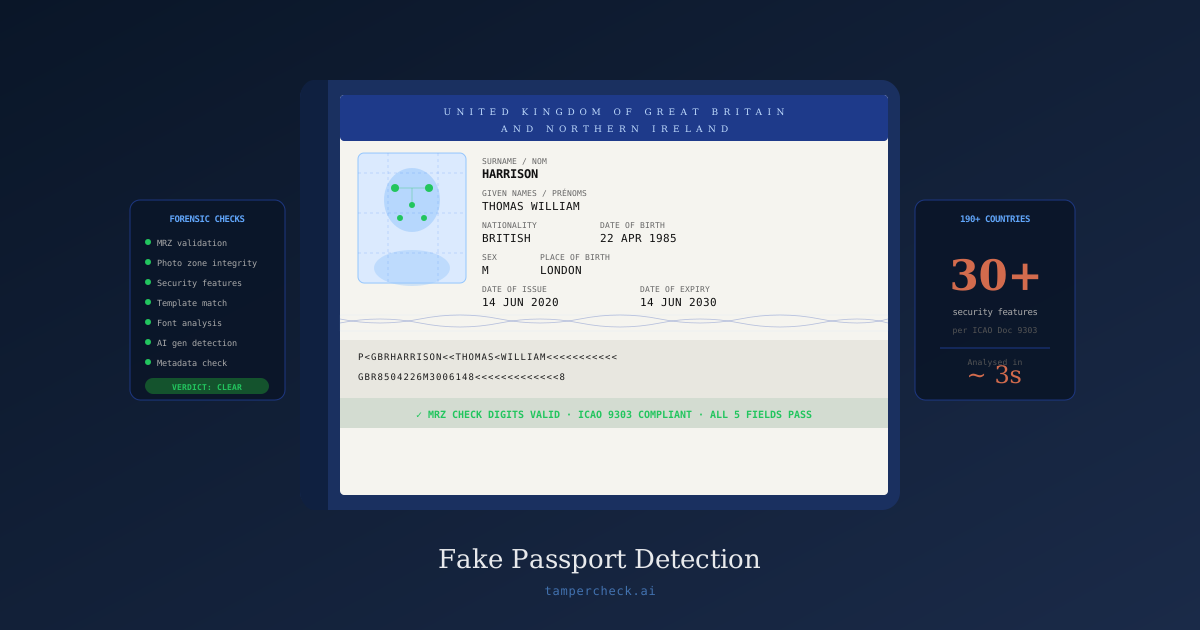
The Threat Landscape: What Fake Passports Look Like in 2026
Passport fraud has evolved from physical forgeries to digital manipulation. The categories in active use:
Altered genuine passports: a legitimate passport with the photo, personal data page, or expiry date changed. This preserves authentic security features while substituting key information.
High-quality counterfeits: laser-printed reproductions of genuine passport designs, sometimes using accurate templates sourced from social media or leaked government PDFs. These pass casual visual inspection.
AI-generated identity documents: generative AI tools can now produce synthetic passport images with plausible data, correct fonts, and accurate layout. These have never been genuine documents.
Document loan fraud: a genuine passport submitted by a third party claiming to be the holder. This is an identity rather than document fraud, but AI verification catches the inconsistency when combined with liveness checks.
The most dangerous passport frauds are altered genuine documents: they carry real security features, real issuing authority signatures, and real MRZ check digits, with only the personal data changed. Forensic analysis must be able to detect these alterations specifically.
Forensic Signal 1: MRZ Validation and Cross-Field Consistency
Every modern passport contains a Machine Readable Zone — two lines of text at the bottom of the data page encoding the holder's details. This zone is governed by ICAO Document 9303, which specifies exact check-digit algorithms for each field.
AI agents validate:
- Check digits: each field (document number, date of birth, expiry date, optional data) has a computed check digit. A single-character change in any field breaks its check digit.
- Cross-field consistency: the nationality code in the MRZ must match the issuing country. The date of birth must be consistent with the stated age. The expiry date must be later than the issue date.
- Visual-to-MRZ match: the name, document number, and dates displayed visually must match the MRZ encoding exactly. Fraudsters who alter only the visual zone (not the MRZ) leave an immediate discrepancy.
Forensic Signal 2: Photo Zone Integrity Analysis
The photo substitution (replacing the genuine holder's image with an impostor's) is the most common form of passport alteration. AI agents analyse the portrait zone specifically:
- Boundary sharpness gradients: a naturally photographed and laminated portrait has smooth, continuous boundaries. A pasted or composited photo has abrupt transitions in noise, sharpness, and colour channel statistics.
- Laminate layer analysis: in genuine passports, the laminate layer creates a uniform optical interference pattern across the photo and surrounding data. Substituted photos show discontinuities in this layer.
- Background consistency: the background colour and texture of the portrait zone should match the template for the specific passport edition. Inserted photos with slightly different background shades are detectable.
Forensic Signal 3: Security Feature Detection
Genuine passports contain security printing features that are forensically detectable even in flat scans:
- Guilloche patterns: the complex, fine-line background patterns on passport data pages have specific spatial frequency characteristics. Low-quality counterfeits simplify or omit these, creating detectable anomalies in Fourier analysis.
- Microprint: text smaller than 0.2mm appears in borders and backgrounds of genuine passports. In scanned or photographed counterfeits, microprint resolves into a blur or is absent entirely.
- Hologram spatial profile: genuine holograms produce characteristic diffraction patterns even in flat photography. AI models trained on genuine holograms can classify hologram presence and authenticity.
- Colour-shifting ink regions: certain fields (like the document number on some passports) are printed with ink that changes colour under different lighting. Scanned reproductions don't replicate this; the captured colour is fixed.
Forensic Signal 4: Template and Layout Matching
Every passport edition has a fixed template: exact field positions, specific fonts, precise spacing. AI agents maintain a database of known-genuine templates and compare submitted documents against them:
- Field position deviation: the date of birth field in a UK passport always appears at the same pixel position relative to the page centre. An altered document may shift this field by fractions of a millimetre — invisible to the eye, measurable by the AI.
- Font classification: different passport-issuing authorities use proprietary or licensed fonts. AI agents classify the font used and compare it against the expected font for the claimed issuing country.
- Colour profile matching: the exact cyan/magenta/yellow/black composition of passport page backgrounds is consistent within genuine documents of the same series.
Forensic Signal 5: Metadata and Digital Provenance
When a passport image is submitted as a digital file, metadata analysis provides additional signals:
- EXIF data: a photo claimed to be taken of a passport should have camera sensor metadata consistent with a genuine photo. Fabricated images often have inconsistent or missing sensor data.
- Compression history: images that have been edited in a graphics application show layered compression artefacts not present in a single-capture photo.
- AI generation signatures: images produced by generative AI tools have statistical properties in pixel noise, high-frequency detail, and edge rendering that are distinct from photographs of physical objects.
Combining Signals for a Verdict
No single signal is conclusive in isolation. An MRZ check-digit failure alone could indicate a transcription error rather than fraud. The AI agent weights each signal and combines them:
| Signal | Confidence Contribution |
|---|---|
| MRZ check-digit failure | High |
| Photo zone boundary anomaly | High |
| Visual-to-MRZ data mismatch | Very high |
| Missing microprint | Medium |
| Font deviation | Medium |
| AI generation signature | High |
A document triggering two or more high-confidence signals generates a "likely forged" verdict. A single medium signal triggers a review recommendation.
The plain-English verdict returned by the AI agent identifies which specific signals were triggered, giving human reviewers the forensic context they need to make a final determination efficiently.
Check a passport or identity document
Upload any identity document and receive a multi-signal forensic verdict in under 3 seconds. Free to start.
Start free →FAQ
- Can AI detect a high-quality fake passport made with genuine security paper?
Physical security paper forgeries are very difficult to detect in flat scans because many physical features (security threads, watermarks) don't appear in digital images. However, MRZ validation, template matching, font analysis, and photo zone integrity checks remain effective regardless of the underlying paper quality.
- Does passport verification AI work for all countries?
Modern document AI agents support 190+ passport-issuing countries, though confidence varies by data availability. Common travel documents (EU/UK/US/Australian passports) have the highest accuracy; less common issuers have wider confidence intervals.
- What's the difference between biometric passport verification and document fraud detection?
Biometric verification (chip reading via NFC) confirms the chip data matches the holder. Document fraud detection analyses whether the physical document has been altered or fabricated; they're complementary, not substitutes. Digital submissions can't be NFC-verified, making forensic analysis the primary tool.
- How does passport fraud relate to deepfake document threats?
AI-generated synthetic passports (created entirely by generative models with no physical original) are the fastest-growing category of passport fraud. These fail the same forensic signals described above (AI generation signatures, missing physical artefacts, MRZ inconsistencies) but require specific model training to catch. See Deepfake Document Fraud in KYC for the full breakdown.
- Where does passport fraud fit in the broader document fraud landscape?
Identity document fraud is the entry point for synthetic identity fraud, KYC evasion, and account takeover. For the full picture across all document types and industries, see the Complete Guide to Document Tampering and Fraud. For how passport forensics fits alongside biometric liveness checks in a KYC stack, see Liveness Detection vs Document Forensics.