Know Your Customer (KYC) compliance requires verifying a stack of documents for every new customer: a government-issued ID, proof of address, and increasingly an income document. At low volumes, trained reviewers can do this manually. At scale (thousands of applications per day), the manual model breaks down in two directions: it's too slow, and it misses too much.
AI agents built for document forensics solve both problems simultaneously.
The KYC Document Stack
A typical KYC workflow requires three document categories:
Identity documents — passports, driver's licences, national identity cards. These must be genuine (not forged or AI-generated), unexpired, and the face photo must match the submitting individual.
Proof of address — utility bills, bank statements, tenancy agreements. These must be recent, match the applicant's stated address, and show no signs of alteration.
Income or financial documents — bank statements, payslips, tax returns. These must be authentic and accurately represent the applicant's financial position.
Each category has distinct fraud vectors. AI agents are trained on the forensic signals specific to each.
Why Manual KYC Review Fails at Scale
A compliance team reviewing 500 KYC applications per day allocates an average of 4–6 minutes per application. That's not enough time to run the forensic checks that AI agents complete in 3 seconds.
The failure modes of manual review are well-documented:
- Fatigue bias: reviewers are less thorough at the end of a shift
- Anchoring: a convincing cover document reduces scrutiny of supporting documents
- Template unfamiliarity: reviewers can't recognise a forged Maltese passport or a Korean utility bill
- No pixel-level forensics: the human eye cannot detect ELA anomalies or font-metric inconsistencies
AI agents don't fatigue, don't anchor, and run identical forensic checks regardless of document origin country.
Layer 1: Identity Document Verification
For passports, driver's licences, and national IDs, AI agents run:
- MRZ validation: the Machine Readable Zone encodes document number, nationality, date of birth, expiry, and a check digit. Any inconsistency between the visual zone and the MRZ is a forgery signal.
- Security feature detection: holographic overlays, guilloche patterns, and microprint have characteristic spatial frequency profiles that distinguish genuine documents from high-quality fakes.
- Photo zone integrity: boundary analysis around the portrait area detects face substitutions and composite images.
- Template matching: document layout, font, and field positioning are compared against known-genuine templates for the issuing country and document version.
- Expiry and date arithmetic: the AI verifies date fields are internally consistent and the document hasn't expired.
Layer 2: Proof of Address Verification
Utility bills and council notices are among the most-forged proof-of-address documents because their layouts are publicly known and easy to replicate:
- Issuer verification: the company name, logo, and ABN/registration number are checked for consistency with known utility providers in the claimed jurisdiction.
- Address field extraction: the verified address is extracted and compared against the applicant's stated address, flagging partial matches or P.O. Box substitutions.
- Date recency: the document issue date is verified to fall within the acceptable window (typically 90 days).
- Structural integrity: column alignment, running balance (for utility accounts), and font consistency are verified across the document.
Layer 3: Income Document Verification
Bank statements and payslips carry the highest fraud incentive — they directly affect lending decisions. The forensic checks here are the most rigorous:
- Arithmetic integrity: balance equations, running totals, and gross-to-net calculations
- ELA and pixel forensics: compression artefact mapping for edited regions
- Font and rendering analysis: character-level metric comparison across all numeric fields
- Metadata cross-reference: PDF creation tool, timestamp, and modification history
- Text layer comparison: OCR versus embedded text layer discrepancy detection
The Human-in-the-Loop Design
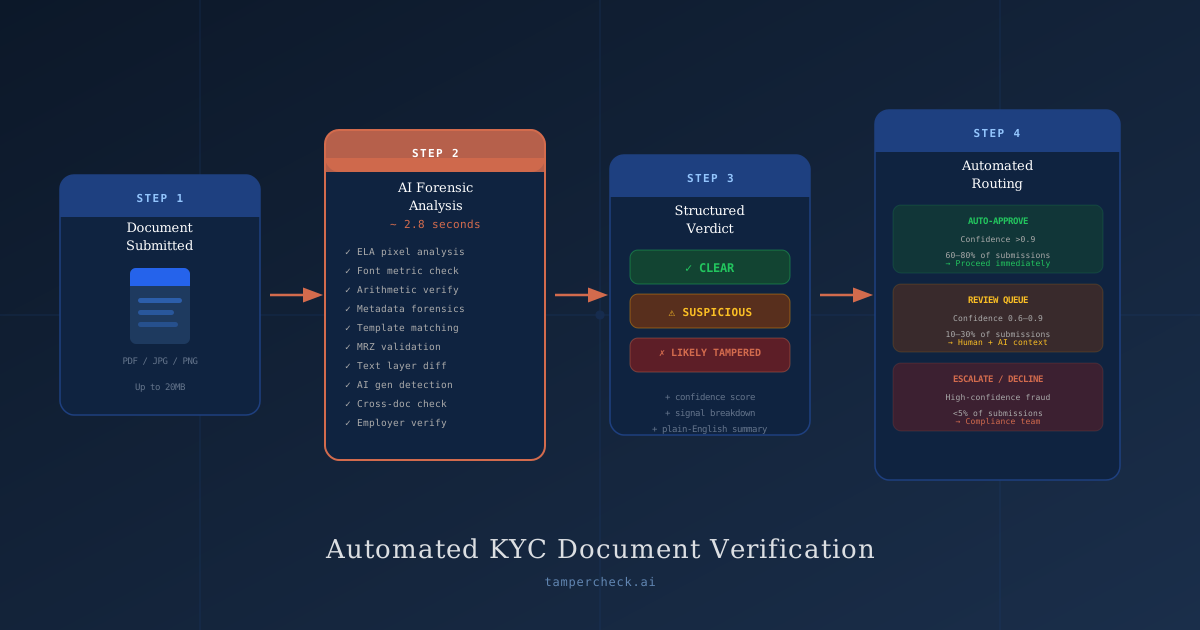
Fully automated KYC doesn't mean zero human involvement. The optimal design uses AI agents to handle the forensic layer and routes documents into three streams:
- Auto-approve: all checks pass, no anomalies — proceed automatically
- Review queue: one or more low-confidence signals — route to a human reviewer with the AI's findings highlighted
- Auto-reject and alert: high-confidence fraud signals — flag for compliance team
This design reduces the volume of documents requiring human review by 70–90%, while ensuring the remaining reviews are better informed by the AI's forensic output.
The AI verdict includes a plain-English summary of every check run and every anomaly detected. Reviewers in the human queue spend their time making judgment calls, not running forensics.
Integration Patterns
AI document verification integrates into KYC workflows via API. The typical integration:
POST /v1/analyse
{
  "document": "<base64-encoded PDF or image>",
  "document_type": "bank_statement",
  "checks": ["arithmetic", "ela", "metadata", "font_metrics"]
}
Response in ~3 seconds:
{
  "verdict": "suspicious",
  "confidence": 0.84,
  "signals": [
    { "check": "ela", "result": "elevated_artefacts", "severity": "high" },
    { "check": "font_metrics", "result": "outlier_detected", "severity": "medium" }
  ],
  "summary": "ELA analysis detected compression anomalies consistent with value substitution in the balance field. Font metrics show an outlier in the closing balance figure."
}
The verdict, confidence score, and signal breakdown feed directly into the workflow engine, triggering auto-approve, review-queue, or rejection logic without manual intervention.
Compliance Considerations
AI-assisted KYC does not remove the compliance obligation; it discharges it more rigorously. Key considerations:
- Audit trail: every AI verdict is logged with the full signal breakdown, creating a documented basis for every KYC decision
- False-positive rate: well-calibrated AI agents maintain low false-positive rates (flagging genuine documents as suspicious), minimising friction for legitimate applicants
- Human override: compliance teams retain the ability to override AI verdicts, with overrides logged for audit purposes
Regulatory guidance from the FCA (UK), FinCEN (US), and AUSTRAC (Australia) all recognise technology-assisted document verification as an acceptable and preferred approach to KYC compliance, provided the system maintains an auditable record of every decision. The EU's AML Authority (AMLA), which began operations in 2025, has similarly endorsed automated document analysis as a component of risk-based AML controls.
For the threat landscape that makes automated KYC essential, see Deepfake Document Fraud in KYC and Synthetic Identity Fraud. For onboarding conversion rate impacts, see How to Cut Onboarding Dropout Without Cutting Fraud Prevention.
Automate your KYC document checks
Try the AI agent on your KYC document stack: get forensic verdicts in under 3 seconds per document. $5 free to start.
Test a fake document →FAQ
- What document types does AI KYC verification support?
Modern AI agents support 100+ document types including passports, driver's licences, national IDs, bank statements, payslips, utility bills, tenancy agreements, and tax documents — across multiple countries and languages.
- How does AI document verification compare to traditional KYC software?
Traditional KYC software focuses on identity matching (face comparison, liveness detection). AI document verification adds the forensic layer: detecting whether the document itself has been tampered with, regardless of whether the face matches. The two layers are complementary.
- Can AI KYC verification integrate with existing onboarding platforms?
Yes. Document verification APIs are designed for webhook or synchronous integration into any onboarding, lending, or compliance workflow. Setup typically takes a few hours with a single API key. See the Document Verification API Developer Guide for a full walkthrough including code examples, response parsing, and webhook setup.