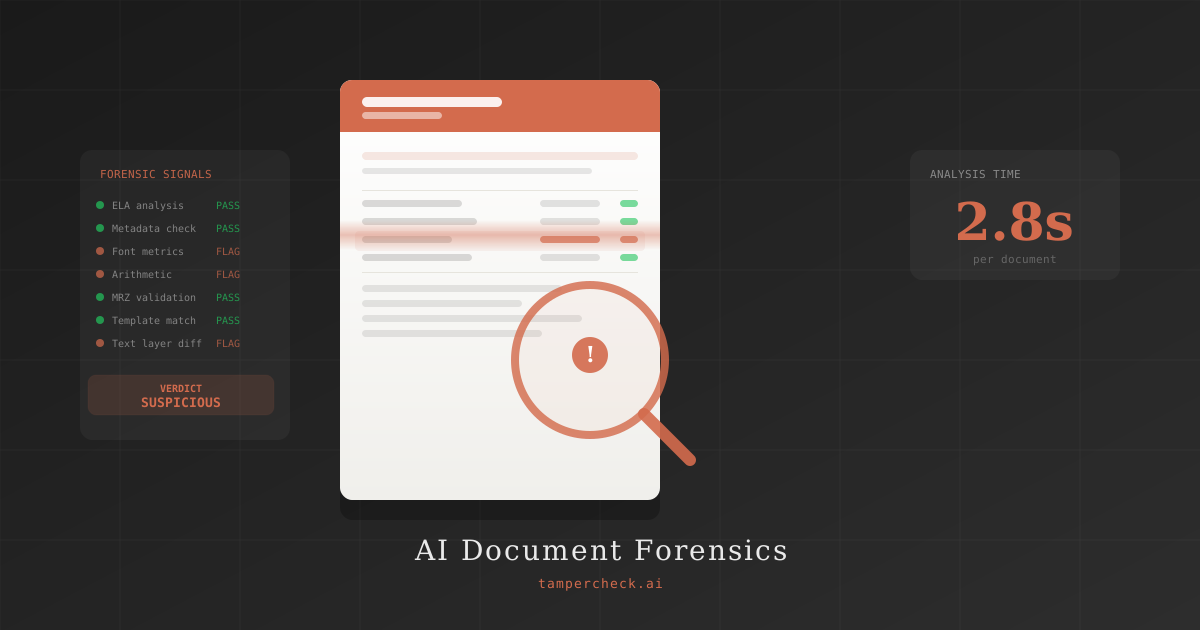
Manual document review catches roughly 1 in 5 fraudulent submissions. The rest (altered bank statements, AI-generated IDs, photo-swapped passports) sail through onboarding, lending, and claims workflows unchallenged. AI agents built specifically for document forensics close that gap by combining four independent analysis layers that no human reviewer can replicate at speed.
What Makes Document Fraud Hard to Spot
The modern fraudster doesn't need Photoshop expertise. Generative AI tools produce convincing payslips, bank statements, and government IDs in minutes — complete with correct fonts, matching branding, and plausible data. Even experienced compliance officers struggle to distinguish these from genuine documents without forensic tools.
The problem compounds at scale. A lending platform processing 500 applications per day cannot afford a forensic review on every income document. The fraud finds the gap.
A single fraudulent loan approval or insurance payout can cost orders of magnitude more than verifying every document submitted. The economics strongly favour systematic verification.
Layer 1: Computer Vision and Pixel-Level Forensics
AI agents begin with computer vision checks that operate below the threshold of human perception. These include:
- Error Level Analysis (ELA): Compression artefacts reveal where pixels were edited and re-saved. Authentic documents have uniform compression; edited regions show distinct noise floors.
- Clone detection: Copy-pasted regions leave statistical fingerprints in pixel distributions — common in fabricated bank statement rows.
- Photo zone analysis: For identity documents, boundary contrast and sharpness gradients around the portrait zone expose face substitutions.
- Hologram and guilloche detection: Security print features have characteristic spatial frequency profiles absent in printed or digitally generated fakes.
Layer 2: Structural and Table Integrity Analysis
Financial documents (bank statements, payslips, invoices) follow predictable layouts. An AI agent checks structural integrity by verifying:
- Running balance arithmetic across every transaction row
- Column alignment consistency (inserted rows rarely match the original grid perfectly)
- Gross-to-net arithmetic on payslips (gross minus deductions must equal net)
- Font metrics across fields (fraudsters often paste new values in a slightly different typeface)
A single row insertion in a 200-row bank statement can be invisible to the eye but statistically detectable in alignment variance analysis.
Layer 3: Metadata and Digital Provenance
Every digital document carries metadata: creation timestamps, software used, modification history, and embedded text layers. AI agents cross-reference this provenance data against the visual content:
- A PDF whose visual content shows a 2024 date but whose metadata records a 2019 creation tool is suspicious.
- A "scanned" document that contains a selectable text layer was likely generated digitally, not scanned.
- Discrepancies between XMP, EXIF, and PDF object metadata indicate post-creation modification.
Layer 4: LLM-Based Semantic and Consistency Analysis
The final layer uses a large language model to analyse the document's content for plausibility and internal consistency. The LLM checks whether employer names are consistent with ABN/EIN formats, whether bank branch codes match the stated institution, and whether the overall narrative is coherent.
This layer also catches AI-generated documents — synthetic text has statistical properties (repetition, over-formality, implausible specificity) that a calibrated LLM can identify with high confidence.
Why This Matters for Businesses Building AI Workflows
As companies integrate AI agents into their operations (automated onboarding, straight-through lending, instant claims processing), the document layer becomes the primary fraud vector. An AI agent that can verify documents in under 3 seconds, return a plain-English verdict, and integrate via a single API call becomes a critical node in any AI-powered workflow.
Try the document AI agent
Submit any document and get a plain-English forensic verdict in under 3 seconds. Free to start.
Start free →FAQ
- How accurate is AI document fraud detection?
Purpose-built AI document agents running multi-layer forensics typically achieve detection rates significantly higher than manual review. The combination of computer vision, structural analysis, metadata checks, and LLM semantic review catches fraud vectors that any single method would miss.
- Can AI detect AI-generated fake documents?
Yes. AI-generated documents have characteristic noise patterns, compression signatures, and text statistics that differ from genuine scanned or photographed documents. Spectral analysis and LLM-based content review are particularly effective.
- How long does AI document verification take?
Modern document AI agents return a verdict in approximately 3 seconds per document, making real-time integration into onboarding and lending workflows practical at any volume.
- What document types can an AI agent verify?
Purpose-built document AI agents support 100+ document types across 190+ countries — including passports, driver's licences, national IDs, bank statements, payslips, utility bills, invoices, professional licences, and tax returns. Explore the specific forensic signals for each: bank statements, payslips, passports, and credentials.
- Is AI document verification relevant for my industry?
If your workflow accepts document submissions as evidence for a financial or compliance decision (lending, insurance claims, KYC onboarding, rental applications, or employment screening), yes. See the Complete Guide to Document Tampering and Fraud for a breakdown by industry and threat vector.