A tenant who can't afford the rent doesn't stop trying to get into the property. They submit fabricated income evidence, inflate their balance, and move in — then struggle with payments from day one. By the time a property manager identifies the problem, the tenant has often accrued weeks of arrears, and an eviction application takes months.
The economics of rental application fraud strongly favour the fraudster: the cost of a fake bank statement (free online tools) is zero; the cost of the fraud (back rent, vacancy, re-letting fees) falls entirely on the landlord.
AI document verification closes this gap at the cheapest possible intervention point: the application.
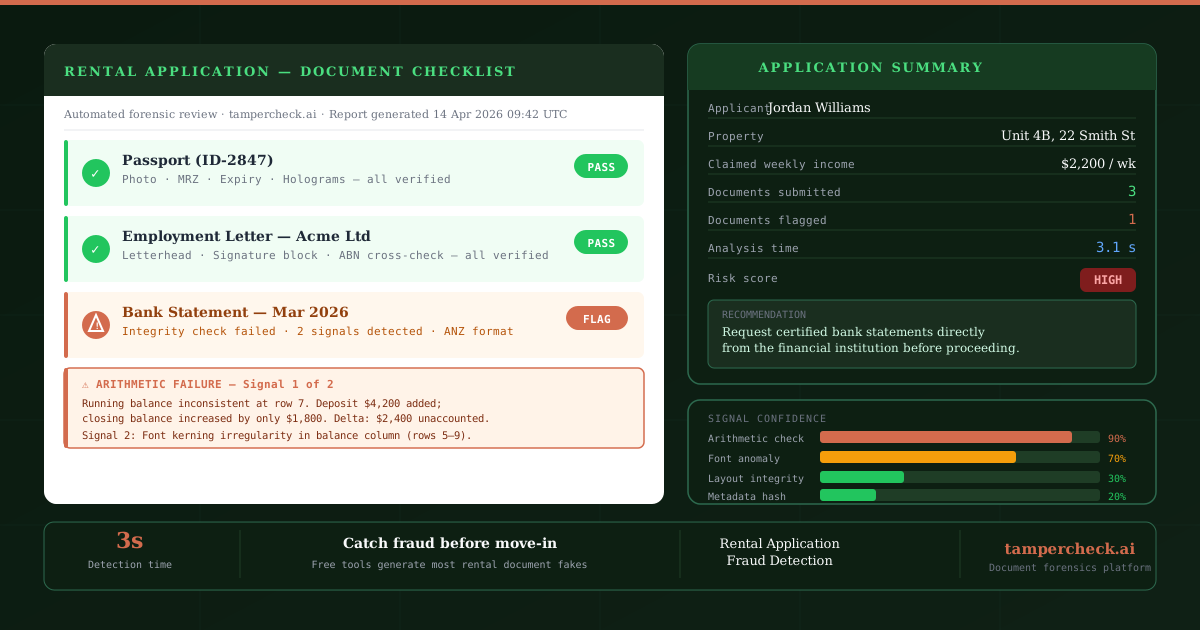
The Rental Application Document Stack
A standard rental application requires:
- Proof of identity: passport or driver's licence
- Proof of income: recent payslips (typically 3 months), bank statements showing salary credits, or a letter of employment
- Rental ledger or references: from previous tenancies
- Proof of address: utility bill or similar
Each document type has specific fraud patterns in the rental context.
Most Common Rental Application Frauds
Inflated Payslip
The applicant has a genuine job paying $55,000 per year — not enough for the listed property requiring $80,000 equivalent income. They open the payslip in a PDF editor, change the gross salary figure, and submit.
What AI catches: gross-to-net arithmetic failure (tax and superannuation deductions no longer correspond to the inflated gross), font metrics outlier on the modified field, potential ELA artefact.
Fabricated Bank Statement
An applicant with irregular income or insufficient savings submits a fake bank statement showing consistent salary deposits and a healthy running balance. Generated using an online bank statement tool.
What AI catches: PDF creator metadata identifies the generator tool, no text layer (genuine bank PDFs have embedded text layers), arithmetic chain may break, structural layout doesn't match the claimed institution's template.
Borrowed Payslip
An applicant submits a friend's or family member's genuine payslip with their own name substituted. The rest of the document is authentic — same employer, same format, same deductions structure.
What AI catches: font metrics outlier on the name field (the substituted name is in a slightly different rendering), ELA artefact at the name region, potential alignment deviation.
Fabricated Employment Reference
A reference letter from a "previous employer" that doesn't exist, or a heavily edited letter from a legitimate employer. These support a fabricated employment history.
What AI catches: ABN/company registration check (non-existent employer), font inconsistencies, metadata showing the document was created by an unexpected tool.
Online rental application fraud has professionalised. Some applicants purchase "full packages": a coordinated fake payslip, bank statement, and reference from services specifically targeting the rental market. These are designed to look coherent across all three documents. Multi-document cross-checking catches inconsistencies that individual document checks might miss.
How Property Management Platforms Can Integrate AI Verification
The integration fits naturally into the document upload step of any rental application workflow:
Applicant uploads payslip PDF
        ↓
Platform submits to verification API (3s)
        ↓
Verdict: clear → flag as verified, proceed
         suspicious → hold, request additional evidence
         likely tampered → decline automatically
The applicant experience is unchanged — the check is invisible to genuine applicants and takes approximately 3 seconds. Only fraudulent submissions are affected.
API Call Example
import httpx, base64, os

def check_rental_document(file_path: str, doc_type: str) -> dict:
    with open(file_path, "rb") as f:
        encoded = base64.b64encode(f.read()).decode()

    return httpx.post(
        "https://tampercheck.ai/api/v1/analyse",
        headers={"Authorization": f"Bearer {os.environ['TAMPERCHECK_API_KEY']}"},
        json={"document": encoded, "document_format": "pdf", "document_type": doc_type},
        timeout=30,
    ).raise_for_status().json()

# Usage
result = check_rental_document("payslip.pdf", "payslip")
if result["verdict"] == "clear":
    proceed_with_application()
elif result["verdict"] == "suspicious":
    request_additional_evidence()
else:
    decline_application()
Cross-Document Consistency Checks
Individual document verification is the first layer. A second layer checks consistency across the full application package:
- The employer name on the payslip should match the employer name in the employment reference
- The salary on the payslip should be consistent with the salary deposits visible in the bank statement
- The name on all documents should match the identity document exactly
- The stated address on application should match the address in the bank statement or utility bill
Inconsistencies across documents that individually pass forensic checks are still a fraud signal — a well-coordinated fraud package might use different fake employer names across documents, or claim different salary figures on the payslip versus the bank statement.
The Property Manager Decision Framework
Not every suspicious verdict warrants automatic rejection. The AI's confidence score and signal breakdown should inform a proportionate response:
| Verdict | Confidence | Recommended Action |
|---|---|---|
| Clear | Any | Proceed |
| Suspicious | < 0.7 | Request original documents or alternative evidence |
| Suspicious | ≥ 0.7 | Decline or request in-person verification |
| Likely tampered | Any | Decline |
The signal breakdown in the API response tells the property manager exactly what triggered the flag, enabling a professional conversation with the applicant if needed ("our system flagged an inconsistency in the income document. Could you provide an original PDF directly from your bank's internet banking?").
Requesting an internet banking PDF directly (rather than accepting an uploaded file) is a low-friction additional verification step for suspicious cases. Genuine bank PDFs have consistent metadata and structure; a re-uploaded, edited version loses these properties.
Cost-Benefit for Property Managers
A single bad tenancy (two months of arrears before eviction, plus vacancy and re-letting costs) can easily exceed $10,000–$20,000. AI document verification costs a fraction of this per check.
The break-even is reached if verification prevents even one fraudulent tenancy per year in a portfolio of any size.
Protect your rental applications
Check income documents at submission — not after move-in. Free to start, no contract.
Test a fake document →FAQ
- Does AI document verification work for self-employed rental applicants?
Self-employed applicants submit different document types (tax returns, BAS statements, accountant letters). AI verification adapts to these document types, checking arithmetic, metadata, and structural integrity. Self-employed income verification has wider tolerance ranges due to the inherent variability of self-employment income.
- Can tenants challenge a rejection based on AI verification?
Property managers should retain the AI verdict and signal breakdown as part of the application record. This provides a documented basis for the decision. As with any automated decision affecting an individual, clear disclosure in the application process that AI-assisted verification is used is good practice.
- Is the service compliant with privacy laws?
Document content is processed in memory and not retained beyond the analysis job. See the TamperCheck Privacy Policy for full details. Platform operators remain responsible for their own privacy obligations to applicants.
- What are the most commonly forged documents in rental applications?
Bank statements and payslips are the most commonly submitted and most frequently forged income documents in rental applications. For the specific forensic signals that expose each: Tampered Bank Statement Detection and Payslip Fraud Detection. For the complete picture of document fraud categories and methods, see the Document Tampering and Fraud Complete Guide.