Onboarding is a negotiation. On one side: compliance and risk, who want more verification steps, more data, more evidence of identity. On the other: product and growth, who know that every additional step loses a percentage of applicants who were genuinely qualified.
The conventional wisdom is that you pick your point on the tradeoff curve — more security means more dropout, less dropout means more risk exposure.
AI document verification moves the curve itself. When forensic checks complete in 3 seconds with a structured verdict, you can run more rigorous analysis while the applicant is still engaged — and route genuine applicants through faster than a manual process ever could.
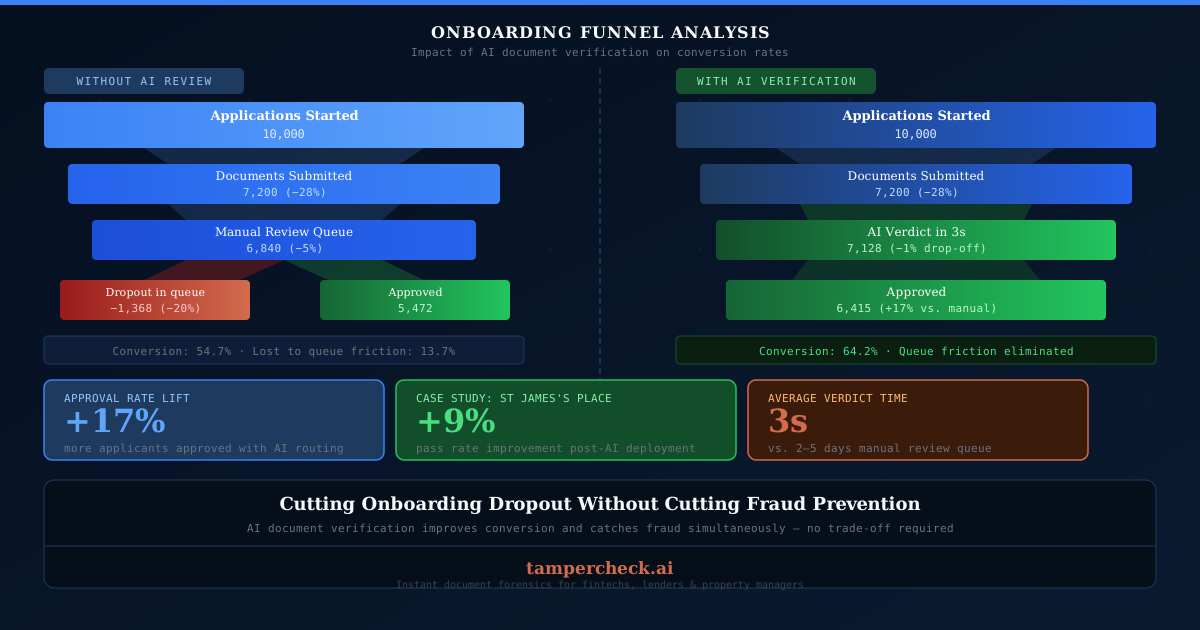
Where Dropout Actually Happens
Most onboarding dropout doesn't happen at the "submit documents" step — it happens in the waiting period after submission.
When document review is manual:
- An applicant uploads their bank statement at 11pm
- The document goes into a review queue
- A reviewer looks at it the next business day
- If something looks off, they request additional evidence — by email
- The applicant, now less engaged, may or may not respond
This is a multi-day, multi-touch process for a decision that should take seconds. Each delay is an opportunity for a genuine applicant to abandon the application, find an alternative, or simply lose interest.
The highest-impact improvement most compliance teams can make to conversion rates isn't removing verification steps — it's making the existing steps instant.
The Three Friction Sources in Document-Heavy Onboarding
1. Wait Time
Manual document review introduces queues. Queue times vary by volume, time of day, and reviewer availability. For an applicant expecting a real-time digital experience, even a 2-hour queue feels broken.
AI verification eliminates this queue entirely. The forensic verdict is returned before the applicant leaves the upload screen.
2. Document Re-requests
Manual reviewers who aren't sure about a document request additional evidence: "Please provide a different bank statement" or "We need a clearer image." These requests create re-engagement loops that many applicants don't complete.
AI forensics returns a structured signal breakdown: if the document is flagged, the system knows exactly why, and can prompt the applicant immediately for the right corrective action ("Your bank statement appears to be a photograph of a screen. Please upload a PDF downloaded directly from your bank's internet banking"). Specific, instant guidance has much higher compliance than a generic "please try again."
3. False Positives Sent to Manual Review
When the review gate is binary — pass or fail — genuine documents with minor quality issues go into a manual review queue alongside suspicious ones. This inflates the queue, slows down genuine applicants, and gives reviewers a high ratio of work that results in approvals.
AI forensics with confidence scores and signal breakdowns enables a tiered routing model:
- High-confidence clear: auto-approve, zero friction
- Low-confidence suspicious: targeted evidence request
- High-confidence tampered: decline with documented basis
This reduces the volume of documents sent to human review by 70–90%, concentrating reviewer attention where it adds value.
How Pass Rate and Fraud Detection Both Improve
The apparent contradiction — fewer friction points and better fraud detection — resolves when you separate "friction" from "verification rigour."
Friction is what genuine applicants experience: wait times, ambiguous re-requests, unexplained rejections. Friction doesn't improve fraud detection — it just makes the process harder for everyone.
Verification rigour is what fraudsters encounter: forensic checks they can't circumvent by being patient or resubmitting slightly different documents.
AI document verification increases rigour (more forensic signals, checked consistently on every submission) while eliminating friction (instant verdicts, specific guidance, no queue). The result:
- Genuine applicants experience a faster, more responsive workflow — improving completion rates
- Fraudulent applicants encounter more rigorous forensic checks — improving fraud catch rates
This is the mechanism behind the +14% pass rate improvements observed in enhanced verification deployments: not fewer checks, but smarter checks that don't impose wait time on genuine applicants.
Practical Implementation: A Tiered Routing Model
Document submitted
      ↓
AI forensic check (< 3s)
      ↓
┌─────────────────────────────────────────┐
│ Confidence > 0.9, all signals pass       │→ Auto-approve, proceed immediately
│ Confidence 0.6–0.9, mixed signals        │→ Targeted re-request (specific guidance)
│ Confidence < 0.6 or high-severity signal │→ Enhanced due diligence queue
│ Multiple high-severity signals           │→ Decline, log for compliance
└─────────────────────────────────────────┘
The enhanced due diligence queue, which previously contained every non-obvious document, now contains only the 10–30% of submissions that genuinely need human judgment. Reviewers spend their time on real ambiguity, not routine verification.
What to Measure
Track these metrics before and after implementing AI document verification:
Conversion metrics:
- Application completion rate (submission to approval)
- Time-to-decision (submission to final verdict)
- Re-request rate (% of applicants asked for additional evidence)
- Re-request completion rate (% who respond to evidence requests)
Fraud metrics:
- Fraud detection rate (tampered documents caught / total tampered submitted)
- False positive rate (genuine documents incorrectly flagged)
- Post-approval fraud rate (fraud discovered after onboarding)
The combination of faster decisions and lower false-positive rates should move all conversion metrics up. If fraud detection rates also improve, you've confirmed the system is working as intended.
TamperCheck returns confidence scores, signal breakdowns, and plain-English summaries on every submission — giving you the data to implement tiered routing without building the forensic analysis layer yourself.
Run forensic checks on your onboarding documents
Add instant document verification to your onboarding flow — improve pass rates and fraud detection simultaneously. $5 free to start.
Start free →FAQ
- Doesn't faster onboarding just make it easier for fraudsters?
Faster decisions for genuine applicants don't make fraud easier — because the forensic checks run regardless of the time taken. Manual review being slow doesn't make it more accurate; it just makes it frustrating for everyone. AI forensics is faster and more rigorous simultaneously.
- How do I justify AI document verification to a compliance team?
The audit trail argument is strong: AI forensics logs every check run and every signal detected, creating a documented basis for every approval and rejection. Manual review creates notes at best. Compliance teams typically prefer the documented forensic record. Regulators including the FCA, FinCEN, and AUSTRAC all recognise automated document verification as an acceptable approach to KYC compliance when it generates an auditable decision trail — see Automated KYC Document Verification for the compliance detail.
- What's the integration effort to add AI document verification to an existing onboarding flow?
A single API endpoint, one call per document, response in ~3 seconds. For most onboarding platforms, this is a half-day integration. See the developer guide for implementation details.