Immigration applications are among the most document-intensive processes in existence. A standard visa application — whether for a skilled worker, student, or family reunification — requires an applicant to produce a passport, financial statements, employment evidence, accommodation proof, and often academic credentials. Each of those documents is a potential fraud vector.
Immigration authorities and consular offices have historically relied on human review and database checks to identify fraudulent documents. Both approaches have structural limits: human reviewers can't consistently detect subtle forensic alterations, and database checks only catch identity fraud — not document-level manipulation.
Forensic document verification at the point of submission — whether by the employer, migration agent, or authority — closes the gap.
The Immigration Document Bundle as an Attack Surface
A visa application doesn't rest on a single document. It rests on a narrative constructed across multiple documents. Fraudsters know this — and they construct document bundles designed to hold up under standard review.
The common documents in an immigration bundle, and their fraud vectors:
Passport / Travel Document — the primary identity anchor. Fraud takes the form of page substitution (replacing the photo or data page), MRZ alteration, or entirely fabricated documents for nationalities with less globally-recognisable passport formats.
Bank Statements — financial sufficiency evidence. The most commonly falsified supporting document. Fraudsters alter balances, add fictitious transactions, or generate entirely fabricated statements using online tools. PDF metadata and balance chain forensics catch both approaches.
Employment Letters — used to demonstrate income source and ties to the home country. Fabricated entirely or altered from genuine letters (changing salary figures, job titles, or company details). Font consistency, letterhead metadata, and employer verification signals catch alterations.
Payslips — corroborating income evidence. Must align with bank statement salary credits. Arithmetic inconsistencies, YTD miscalculations, and PDF creator metadata are primary detection signals.
Academic Credentials — required for skilled worker and student visas. Fabricated degree certificates and transcripts carry document-structure tells that forensic analysis identifies against genuine issuer templates.
Accommodation Letters / Tenancy Agreements — proof of accommodation at the destination. Commonly altered from genuine templates.
How Forensic Document Verification Works in the Immigration Context
Each document in the bundle is analysed independently against forensic signals, and then cross-checked for consistency across the bundle.
Individual Document Analysis
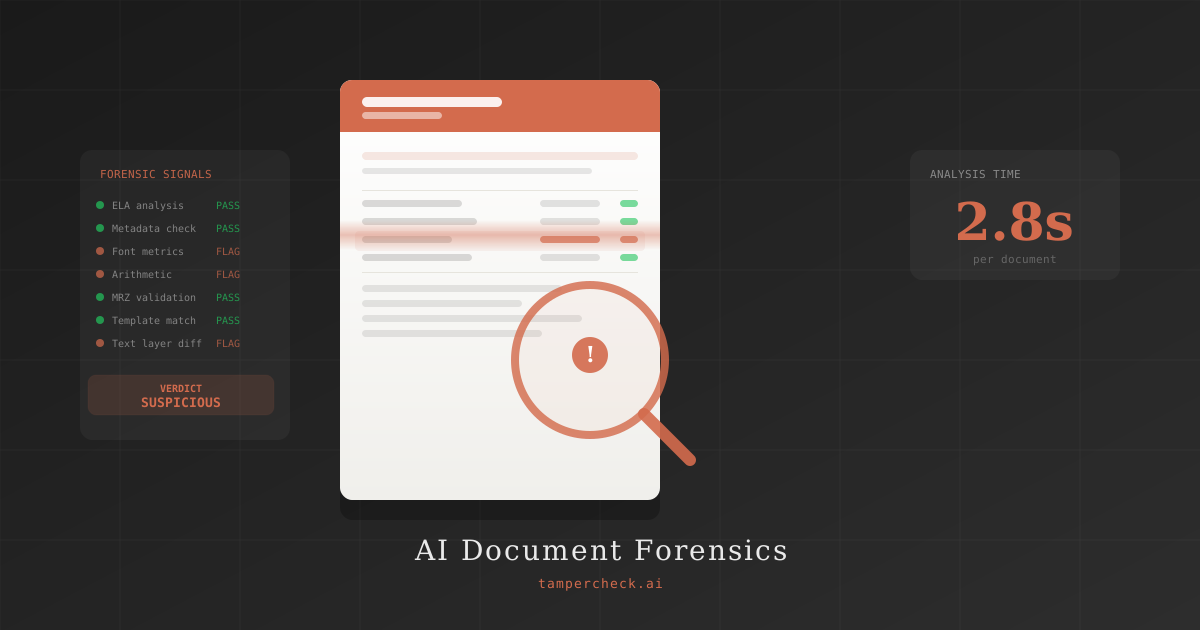
Pixel-level forensics examines each document for signs of digital manipulation: compression artefact discontinuities at boundaries of altered regions, cloning artefacts where content has been duplicated, and error-level analysis (ELA) mapping that reveals areas re-saved at different compression quality.
Metadata extraction reads the document's internal metadata — PDF creator application, creation and modification timestamps, author fields, and embedded font tables. A bank statement purportedly printed from an online banking portal but carrying the metadata signature of a desktop publishing application fails immediately.
Structural validation checks document structure against known genuine document templates from the claimed issuer: font families, table structure, header/footer positioning, and numerical formatting conventions.
MRZ validation (for passports and ID cards) verifies that the machine-readable zone's check digits validate against the printed data. Manual MRZ alterations frequently leave check digit errors that are invisible to human review but trivially detected algorithmically.
Cross-Document Consistency
Immigration fraud is most reliably caught not from any single document but from inconsistencies across the bundle:
- Employer name on employment letter vs. employer name on payslip vs. salary credit description on bank statement
- Address on bank statement vs. address on accommodation letter vs. address on employment letter
- Salary figure on employment letter vs. monthly credit amount on bank statement
- Date ranges: employment start date vs. earliest statement date vs. payslip period
A fraudulent immigration bundle is typically internally consistent at the level of a casual read. The inconsistencies — different salary formatting between payslip and bank statement, an employer ABN that doesn't match the trading name, a font substitution on a single line of an employment letter — require systematic forensic analysis to surface.
Who Should Run Document Forensics in the Immigration Chain
Document verification at the immigration layer can be applied at multiple points in the process:
Registered Migration Agents and Immigration Lawyers — who assemble and submit application bundles on behalf of applicants. Adding forensic verification before submission protects the agent's professional registration and prevents them from unknowingly submitting fraudulent documents.
Employers Sponsoring Skilled Worker Visas — who must collect and vouch for applicants' supporting documents. Sponsor liability in many jurisdictions attaches to employers who submit or rely on fraudulent documentation.
Document Collection Platforms — SaaS platforms that collect supporting documents from applicants on behalf of agents or authorities can embed forensic verification at upload, returning verdicts before documents are forwarded.
Government Authorities and Consulates — running batch verification against large submission volumes to triage high-risk applications for enhanced human review.
Building the Verification Layer
The practical integration is a single API call per document:
POST /v1/verify
{
  "document": "<base64>",
  "document_type": "bank_statement",
  "claimed_issuer": "Barclays UK"
}

Response:
{
  "verdict": "tampered",
  "confidence": 0.94,
  "signals": [
    "balance_chain_discontinuity",
    "pdf_metadata_mismatch",
    "font_substitution_detected"
  ]
}
For bundles, cross-document consistency checks run as a second pass after individual verdicts, returning a composite bundle risk score.
TamperCheck handles both layers — individual document forensics and cross-document bundle analysis — via the same API, covering 100+ document types including passports, bank statements, payslips, employment letters, and academic credentials.
Add immigration document forensics to your verification flow
Catch tampered supporting documents before they reach the consulate. $5 free to start, no storage.
Test a fake document →FAQ
- Which immigration documents are most commonly fraudulent?
Bank statements and payslips are the most frequently falsified supporting documents — they're easy to alter digitally and financial sufficiency is a requirement for most visa categories. Employment letters and payslips are the second most common fraud vector. Passport fraud, while higher profile, is less frequent because of higher technical barriers.
- Can forensic verification catch fraudulent documents from any country?
Yes — forensic analysis operates on the document's intrinsic properties (pixel forensics, metadata, structural signals) rather than checking against a specific national database. It catches alterations and fabrications regardless of the document's claimed country of issue.
- Does running document forensics create any data storage risk?
Not with a zero-storage API. TamperCheck processes documents ephemerally — documents are analysed in memory and not retained after the verdict is returned. This is important for immigration documents, which contain sensitive personal data subject to data minimisation requirements under GDPR and equivalent frameworks.
- How does forensic verification interact with existing biometric checks?
They're complementary, not overlapping. Biometric checks verify that the person presenting a document matches the person in the document. Forensic verification checks whether the document itself is genuine. Both are necessary: a genuine passport with a legitimate biometric can still have an altered data page.