University admissions teams review thousands of academic transcripts, degree certificates, and marksheets each cycle. The assumption embedded in that process — that submitted documents accurately represent the applicant's academic record — is increasingly untenable.
Fabricated transcripts and altered marksheets are not exotic fraud. They're a growing, well-documented problem at every level of education: undergraduate admissions, postgraduate programmes, professional accreditation, and study abroad applications. The services that produce fraudulent academic credentials are readily available online, inexpensive, and increasingly convincing.
The admissions process doesn't currently have a systematic answer. Document review is manual, inconsistent, and based on visual inspection. Verification through the issuing institution is slow and dependent on cooperation. Neither approach catches the forensically sophisticated fraudulent document that looks right to a human reviewer but carries detectable manipulation signals in its structure, metadata, and pixel data.
The Education Document Fraud Landscape
Academic credential fraud in admissions takes several distinct forms:
Fabricated Transcripts — generated to show grades and courses the applicant never took. The global market for fabricated transcripts is well-established: document mills produce convincing-looking transcripts from real institutions, and bespoke services produce documents tailored to specific admission requirements. These are entirely fictitious documents.
Altered Genuine Transcripts — real transcripts from the applicant's actual institution, digitally edited to improve grades, add courses, or change degree classifications. These are harder to detect visually because the underlying document structure is genuine; only the altered fields carry forensic manipulation signals.
Degree Certificate Fraud — certificates claiming a degree the applicant doesn't hold, from an institution they may or may not have attended, at a classification they didn't achieve.
Marksheet Fraud — particularly prevalent in South Asian and Southeast Asian education systems, where marksheets are the primary academic credential. Fabricated or altered marksheets claim subject scores and aggregate marks that weren't achieved.
Admission Letter Misuse — altered acceptance letters used to obtain student visas or justify conditional offers at other institutions.
Grade Inflation Fraud — altering a genuine transcript to change individual grades while leaving the overall structure intact. This is among the most forensically detectable forms because the altered fields carry different compression and font signatures than surrounding unaltered content.
Why Manual Admissions Review Fails to Catch Document Fraud
Admissions officers review documents under significant time pressure. A typical admissions cycle involves hundreds to thousands of applications, each with multiple supporting documents. The conditions for reliable forensic detection — controlled environment, adequate time, forensic tools — don't exist in an admissions office.
The failure modes of manual review:
Visual similarity is not authenticity: a well-produced fabricated transcript from a real institution's template is visually indistinguishable from a genuine one to a reviewer who hasn't seen hundreds of genuine documents from that specific institution in that specific period.
Verification delays create bottlenecks: direct verification with issuing institutions — the only reliable manual check — requires international communication, institutional cooperation, and days to weeks per application. It doesn't scale to high-volume admissions.
Consistency checking is not systematic: a human reviewer may notice that a GPA on the transcript doesn't match the cumulative GPA on the covering statement, but they won't systematically check arithmetic consistency, date logic, or cross-document field agreement across every application.
The most sophisticated education fraud targets programmes that don't verify directly with issuing institutions — relying instead on the visual plausibility of submitted documents. These programmes are the most exposed.
What Forensic Analysis Catches in Academic Documents
Transcripts
Transcripts from major educational institutions carry consistent structural properties. Forensic analysis checks:
Font consistency: genuine transcripts use institution-specific fonts applied consistently throughout. Altered transcripts frequently show font substitution in edited fields — the grade cell uses a slightly different weight or character spacing than surrounding cells.
Table structure integrity: transcript tables have precise geometric properties. Editing tools that modify cell content often introduce sub-pixel inconsistencies in cell boundaries, column widths, or row heights that pixel-level analysis surfaces.
Arithmetic validation: cumulative GPA, weighted averages, credit totals, and percentage aggregates are mathematically derivable from component grades. Fabricated or altered transcripts frequently fail arithmetic consistency checks.
Date logic: course completion dates, semester markers, and transcript generation dates must follow logical sequences. Fabricated documents frequently introduce date inconsistencies (courses completed after transcript generation date, or semester codes that don't exist for the claimed year).
Metadata forensics: a PDF transcript generated by an institution's student records system carries specific metadata signatures. A transcript generated in Microsoft Word or an online PDF editor carries entirely different metadata — including creator application, creation timestamp, and font embedding tables.
Degree Certificates
Institution-specific template analysis compares submitted certificates against known genuine document structures:
- Seal dimensions and positioning
- Signature field formatting
- Degree designation formatting conventions (BA vs B.A., Honours classification language)
- Paper texture signals in scanned physical documents
- QR code or verification URL presence and validity (for institutions that embed them)
Marksheets
Marksheet fraud in South Asian education systems is a high-volume problem for international admissions. Forensic analysis targets:
- Board-specific header and table formatting (CBSE, ISC, state boards each have distinct templates)
- Subject code formatting and validity
- Aggregate and percentage arithmetic
- Watermark and security feature replication quality
Integrating Document Forensics in Admissions
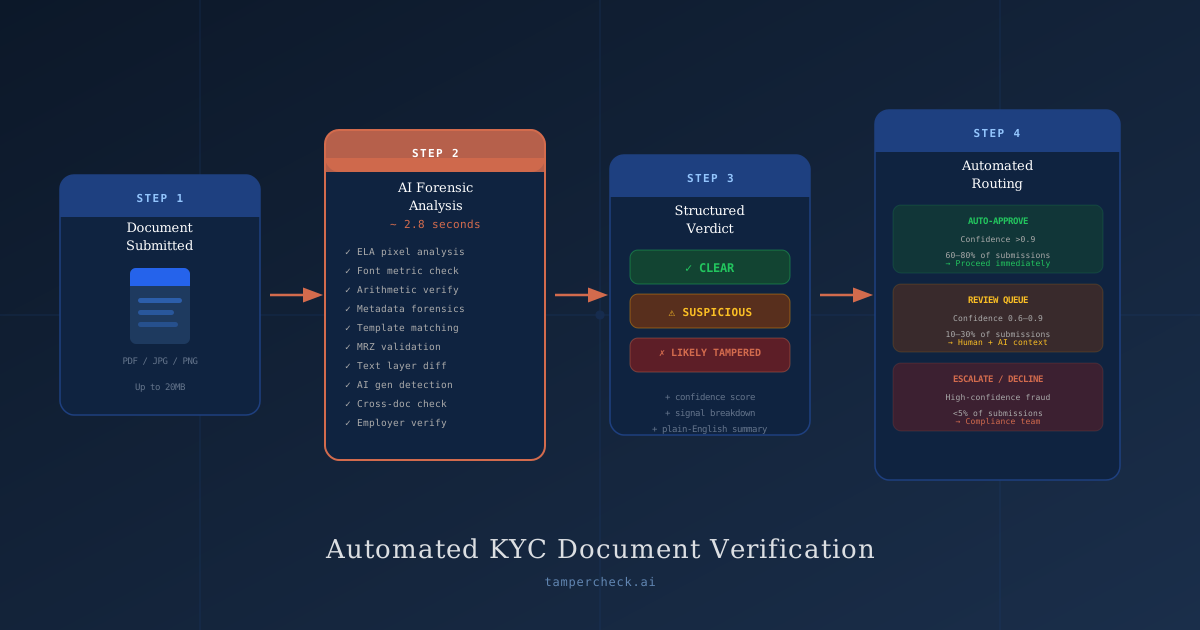
The integration fits at the point of document upload in the application portal:
Applicant uploads academic documents
              ↓
Forensic verification API (per document, ~3s)
              ↓
Risk score returned: low / medium / high
              ↓
Low risk → standard admissions review
Medium risk → flagged for closer review, verification request
High risk → excluded from review pool, applicant notified
For high-volume programmes, this acts as a triage layer: the majority of applications pass forensic review and proceed normally; a smaller set is flagged for enhanced scrutiny or direct verification with the issuing institution.
This model inverts the current approach — instead of trying to verify everything slowly, it identifies which documents warrant verification resources.
TamperCheck covers transcripts, degree certificates, marksheets, and admission letters across 100+ document types, with support for documents from institutions globally.
Add forensic document verification to your admissions workflow
Stop fake transcripts and altered marksheets before they consume admissions resources. $5 free, no storage.
Test a fake document →The Downstream Cost of Admissions Fraud
A successful fraudulent admission creates costs well beyond the initial review:
Programme integrity: a student admitted on fraudulent credentials lacks the prerequisites the programme assumes. This creates disproportionate demand on teaching staff and cohort disruption.
Graduation outcome risk: if a fraudulent student completes the programme (facilitated in some cases by continuing academic fraud), the graduate credential becomes a misrepresentation. Downstream employers relying on the credential bear the downstream risk.
Reputational exposure: publication of fraud cases — particularly in international admissions — damages institutional reputation and the value of genuine credentials from the same institution.
Regulatory risk: for programmes with professional accreditation (medicine, law, accounting), admitting unqualified students may create accreditation exposure.
Visa fraud linkage: in international student admissions, document fraud in the academic credential is frequently part of a broader fraud including student visa applications. Detecting academic credential fraud at admission may surface linked visa application fraud.
FAQ
- Does forensic verification replace direct verification with issuing institutions?
For high-confidence cases (clear fabrication or obvious alteration), forensic verification provides faster resolution than waiting for institution verification. For medium-confidence cases, forensic results inform which applications warrant the time investment of direct verification. They're complementary rather than substitutes.
- Can the system verify transcripts from institutions in any country?
Yes — forensic analysis operates on the document's intrinsic properties and does not require a database of every institution's template. It detects manipulation signals regardless of the issuing country. For institutions with well-documented template signatures, structural matching adds additional verification depth.
- What about digital transcripts sent directly from institutions?
Transcripts delivered directly by institution (e.g., through National Student Clearinghouse, UCAS, or equivalent systems) don't require the same forensic scrutiny — the chain of custody is verified. Forensic verification is most valuable for applicant-submitted documents, where the chain of custody relies on the applicant's honesty.
- How do we handle applicants whose genuine documents are flagged?
A forensic verdict is a signal, not a final determination. A 'suspicious' verdict on a genuine document can result from poor scanning quality, institutional template variation, or aggressive compression. The response to a suspicious verdict is to request re-submission (higher quality scan, or original) and if necessary to verify directly with the institution — not to reject the application automatically.
- Is this relevant for domestic as well as international admissions?
Yes. Domestic transcript fraud is less commonly discussed but well-documented. Grade inflation fraud (altering a genuine domestic transcript) is forensically detectable and occurs in domestic as well as international applicant pools.